Our group employs advanced X-ray scattering spectroscopies to explore the mechanisms of unconventional superconductivity, probe exotic orders and collective excitations in quantum materials, and unravel the dynamics of collective excitations and quantum phase transitions.
Equilibrium Studies
We utilize both non-resonant and resonant X-ray scattering techniques to investigate charge, spin, and orbital orders in novel materials.
We employ resonant inelastic X-ray scattering (RIXS) to study collective excitations, including charge, spin, lattice, and orbital excitations in quantum materials.
Non-Equilibrium Studies
We employ pump-probe time-resolved resonant X-ray scattering to study the time dynamics of materials. This technique involves exciting the material into a transient state using an optical pulse and then measuring it with an X-ray pulse. The time delay between the two pulses is adjustable to measure charge, orbital, spin, and lattice relaxation dynamics.
Quantum phase transitions with in-house XRD instrument
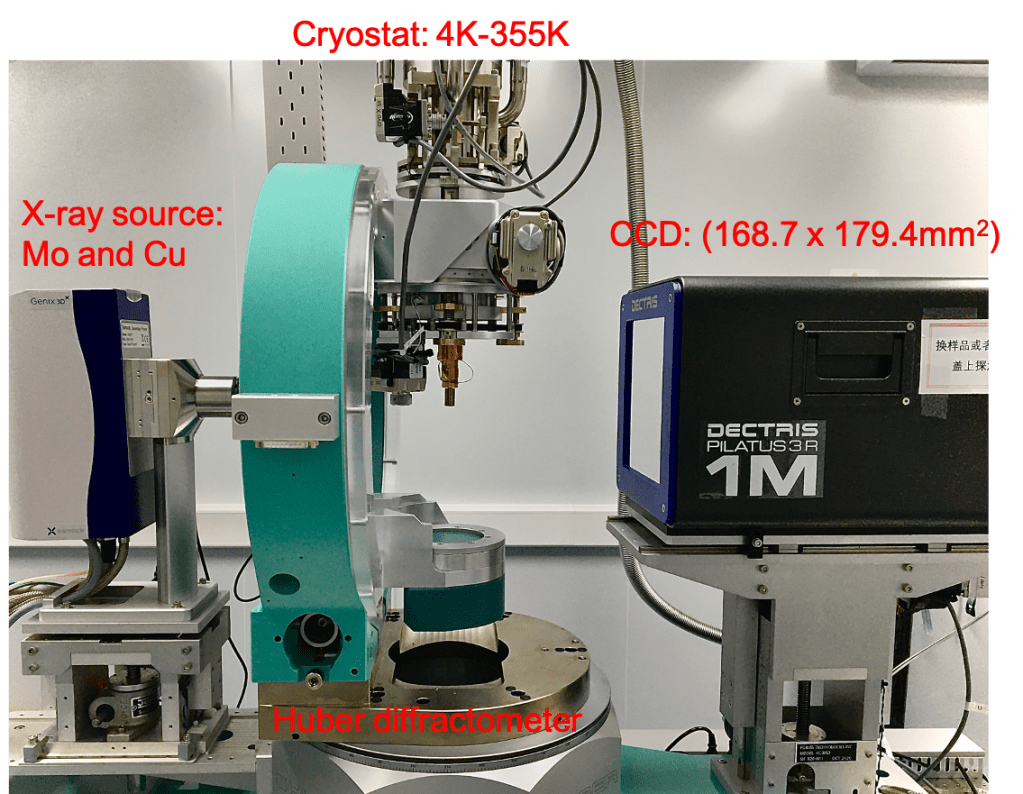
Our group employs an in-house four-circled X-ray diffraction instrument, featuring a highly sensitive two-dimensional detector, to investigate structure transitions and charge-density-wave transitions in novel quantum materials.
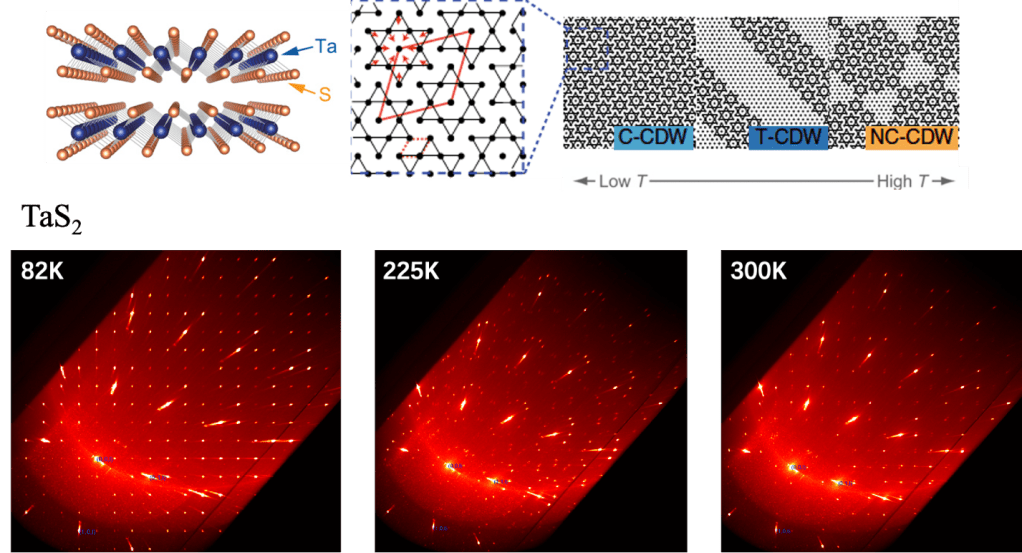
Our temperature measurements on the various CDW phases in TaS2 using our in-house XRD
Experiments at international synchrotron x-ray radiation facilities and x-ray free electron lasers
We also lead many experiments at international synchrotron and X-ray free-electron laser facilities across Asia and Europe, enhancing our research capabilities and enabling groundbreaking discoveries.
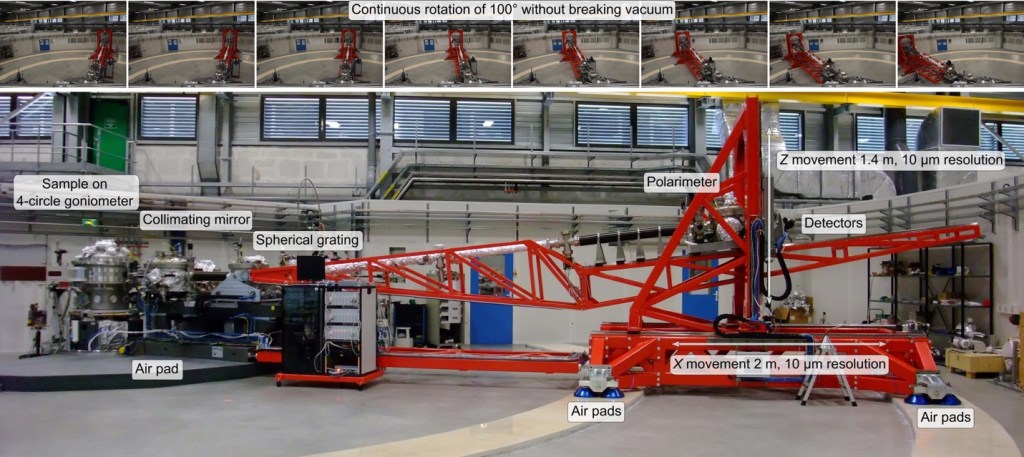
Resonant inelastic x-ray scattering (RIXS) instrument at the European Synchrotron (ESRF) in Grenoble, France
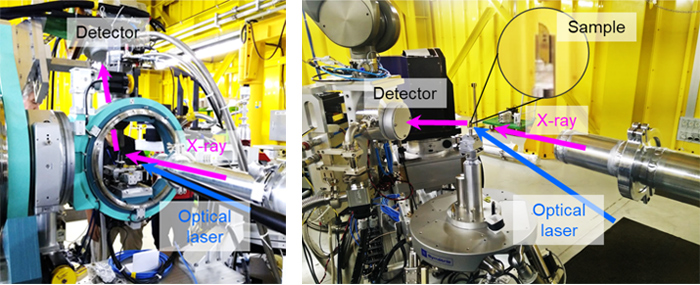
The FXS (Femtosecond X-ray Scattering) endstation at Pohang Accelerator Laboratory X-ray Free Electron Laser facility (PAL-XFEL) at Pohang, Republic of Korea

